
São José dos Pinhais (PR)
Completed
PARQUE SÃO JOSÉ
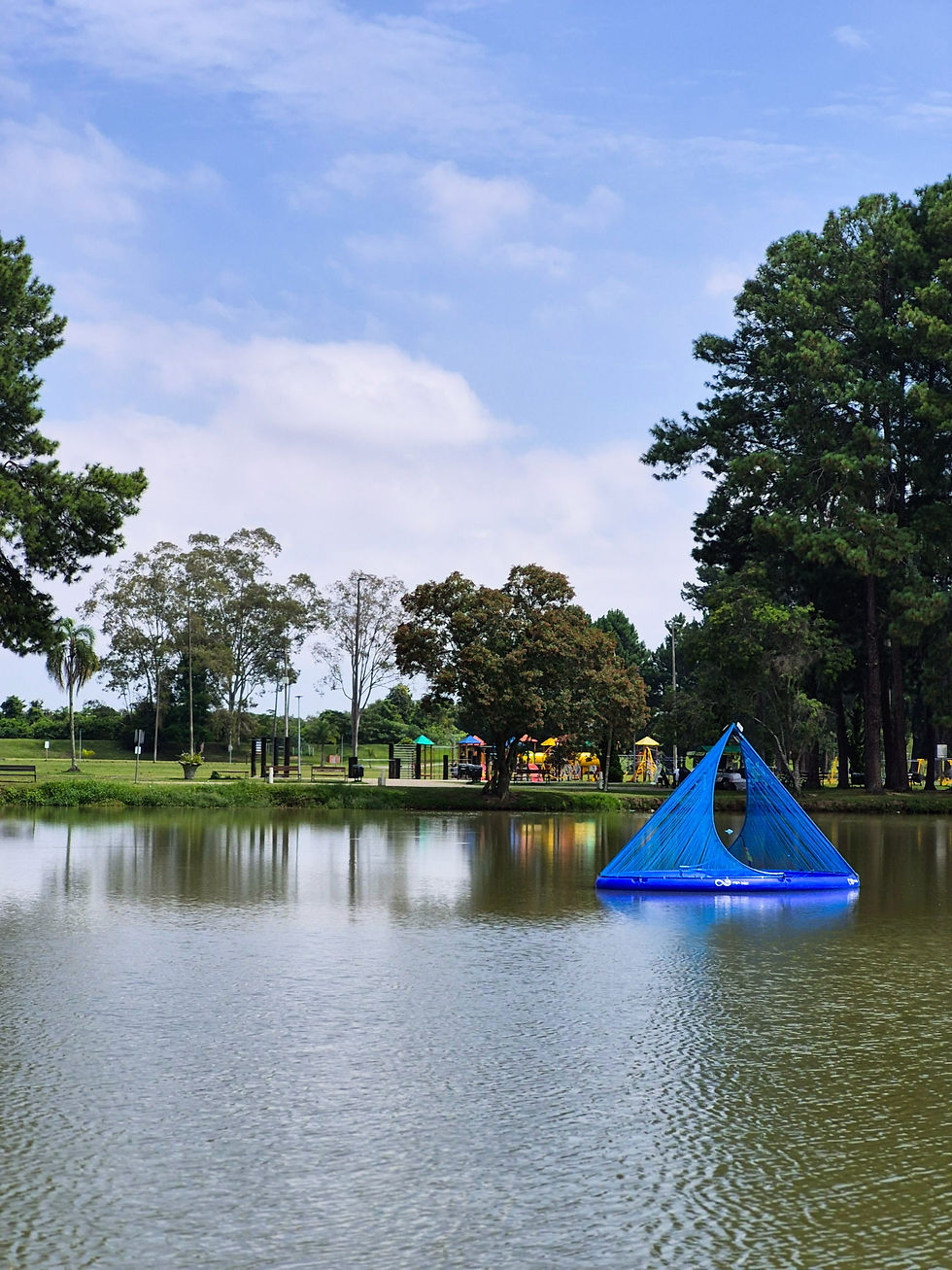
The Caravela was installed at Parque São José, in São José dos Pinhais, in partnership with the Instituto Água e Terra (IAT), part of the State Government of Paraná, and the City of São José dos Pinhais.
Set within the city’s urban landscape, the park’s lake is a place where nature,
infrastructure, and community life come together, revealing the importance of urban water bodies for environmental quality and everyday life.
Here, water is more than part of the landscape. It supports biodiversity,
drainage, and urban resilience.
Urban lake environment
March to July 2026
WHY THIS TERRITORY MATTERS
Parque São José is a territory where water is given space to stay.
Designed as a sponge park, it helps absorb, store, and channel rainwater, contributing to the city’s resilience.
The arrival of the Caravela in this environment marked the beginning of a technical demonstration for watershed managers across Paraná, bringing science, innovation, and nature closer together.
More than testing a technology, this territory invites us to imagine new ways to monitor, regenerate, and care for water in cities.
More than a local operation, the project expands the conversation around water management, climate adaptation, and environmental innovation, showing how nature-based solutions can also help shape
the future of cities.


Demonstration of nature-based solutions for water management
Continuous ecological monitoring
Environmental data generation
Citizen science
Nature-based ecological remediation
Environmental education
CARE, BUILT TOGETHER
The project was led by Infinito Mare in partnership with the Instituto Água e Terra (IAT), part of the State Government of Paraná, and the City of São José dos Pinhais.
The territory served as a demonstration site for public officials and professionals involved in water resources management across Paraná, strengthening the dialogue between innovation, public policy, and environmental conservation.
Research and analyses associated with the operation ere carried out in collaboration with the Federal University of Paraná (UFPR) and the University of São Paulo (USP), supporting investigations into biodiversity, the presence of metals, and the characterization of organic compounds throughout the operation.

WHAT THIS WATER REVEALED
The operation in São José dos Pinhais allowed us to observe different cycles of the Caravela’s development in the lake.
Throughout the project, sampling, observations, and field activities revealed the evolution of biomass, the succession of ecological processes, and the aquatic system’s response to the presence of the technology.
The territory also deepened our understanding of how the Caravela performs in urban lake environments, where water, drainage, biodiversity, and green infrastructure are all part of the same system.
More than generating data, the experience brought science, innovation,
and public management closer together, opening new possibilities for rethinking how we care for urban waters and adapt our cities.
São José dos Pinhais reminded us that every body of water has its own rhythm, and that understanding that rhythm is also part of regeneration.
Arriving in the territory


Partnerships for care

A new chapter


Science in the making

The beginning of the cycle


WHAT THIS TERRITORY REPRESENTS
São José dos Pinhais represents a new milestone in Infinito Mare’s journey. More than an operation in an urban environment, the territory became a space for demonstration, learning, and knowledge building.
It was here that Infinito Mare secured its first public-sector contract, marking a new stage for the technology in working with public institutions and addressing real-world challenges in water and environmental management.
The partnership with the Instituto Água e Terra (IAT) and the City of São José dos Pinhais expanded the Caravela’s dialogue with water resource managers, watershed authorities, and public policies focused on water.
More than a local project, this territory demonstrated the potential to scale the technology’s application, strengthening the integration of science, nature, and public management.
The knowledge and insights gained here continue to open new possibilities for application across other territories in Paraná and in different water management contexts throughout Brazil.
Here, the Caravela completed a cycle. But the lessons this water left behind continue to open new paths.