RESULTS
PORTO ALEGRE (RS), BRAZIL
September – December 2025 · 2 Caravelas · 2 aquatic territories · 77 days of operation
GUAÍBA + ARROIO DILÚVIO
A NOTE ON THE DATA
The results presented on this page reflect the most recent consolidation of operational data. As new analyses are completed and the dataset is updated, some indicators may vary from figures shared in previous versions.
Data updated in September 2026.
BETWEEN THE ARROIO
AND THE GUAÍBA,
A CITY REVEALS ITSELF
THROUGH WATER.
In Porto Alegre, two Caravelas operated simultaneously in two aquatic systems within the same city.
One in the Guaíba, near Parque Pontal.
The other in Arroio Dilúvio, which crosses the city before meeting the Guaíba.
Same technology.
Same city.
Profoundly different waters.
Throughout the operation, biomass, contaminants, and retained elements revealed distinct responses in each body of water.
Porto Alegre showed us, in practice, that there is no single kind of water.
These are some of the results from that experience.

RESULTS AT A GLANCE
THE NUMBERS TELL PART OF THE STORY.

TWO WATERS
THE SAME TECHNOLOGY.
TWO COMPLETELY
DIFFERENT RESPONSES.
Guaíba and Arroio Dilúvio are part of the same urban water system.
Yet throughout the operation, the Caravelas revealed very different conditions across the two environments.
In the Guaíba, near Parque Pontal, an open body of water shaped by circulation, winds, and the dynamics of a much larger water system.
In Arroio Dilúvio, an urban waterway that crosses a densely developed watershed before meeting the Guaíba.
These differences were also recorded in the biomass.
GUAÍBA
80 G OF METALS
removed with the biomass
ARROIO DILÚVIO
340 G OF METALS
removed with the biomass


ENVIRONMENTAL CHARACTERIZATION
THE BIOMASS
ALSO BECAME A WAY OF READING THE CITY.
GUAÍBA · PARQUE PONTAL

*Values represent the relationship between the concentrations identified in the biomass and the reference values used in the analysis. They do not represent concentrations measured directly in the water.
Biomass analyses allowed us to compare
the elements retained at the two operation sites
and observe very different profiles.
In the Guaíba, some of the highest values identified
in the biomass were associated with aluminum, phosphorus,
titanium, iron, manganese, and copper.
ARROIO DILÚVIO
In Arroio Dilúvio, the biomass revealed
a different composition and different magnitudes.

* Values represent the relationship between the concentrations identified in the biomass and the reference values used in the analysis. They do not represent concentrations measured directly in the water.
Together, the two profiles create a kind of
fingerprint for each body of water.
EACH WATER
LEFT A DIFFERENT
MARK IN THE BIOMASS.
The two sites share some of the same elements, but in different proportions and concentrations, reinforcing the picture of two distinct environmental contexts
within the same urban water system.


POLLUTANTS
TWO WATERS.
DIFFERENT TRACES
OF URBAN LIFE.
The analyses investigated different classes
of compounds associated with human activities
and the dynamics of an urban watershed.
PCBs. Fecal sterols. Pesticides.
Aliphatic and aromatic hydrocarbons.
Metals. Nutrients.
Among the compounds identified in the biomass,
two help reveal how different traces
of the city can persist and circulate through water.
Among the compounds identified were:

DDT
A POLLUTANT FROM THE PAST
THAT CAN STILL PERSIST IN THE PRESENT.
DDT is a persistent organic pollutant, known for remaining in the environment and breaking down very slowly.
Even decades after restrictions on its use, its residues can remain associated with sediments, water, and organisms.
Its identification in the Caravelas’ biomass reveals how substances used in the past can continue to leave traces
in aquatic ecosystems.
PHTHALATES
TRACES OF PLASTIC USE
ALSO FIND THEIR WAY INTO THE WATER.
Phthalates are compounds used in a range of everyday materials and products, particularly as plasticizers.
Because they are not necessarily bound to the structure of these materials, they can be released over time and reach soils, sediments, and aquatic environments.
Their identification in the biomass points to the Caravela’s potential to retain compounds associated with contamination from plastic materials,
removing them from the system along with the harvested biomass.
WHAT A CITY USES, DISCARDS, AND TRANSFORMS ALSO LEAVES TRACES IN THE WATER.

CLIMATE & RESILIENCE
WHEN THE WEATHER CHANGES, THE WATER CHANGES TOO.
During the operation, Porto Alegre experienced heavy rainfall, strong winds, and severe weather events, including an extratropical cyclone that affected the region.
Changes in weather altered the conditions at both sites where the Caravelas were installed.
And each body of water responded in its own way
ARROIO DILÚVIO
WHEN IT RAINS,
THE ARROIO CARRIES
MUCH MORE THAN WATER
Channelized and running through a densely urbanized watershed, Arroio Dilúvio responds rapidly to heavy rainfall.
As water flow increases, branches, trees, and large debris are carried by the force of the water, creating particularly challenging operating conditions.
Even secured with two anchors and an additional safety line, the Caravela was displaced twice following episodes of heavy rain and strong winds, as these materials were swept downstream and struck the structure.
During the operation, records from the waterway helped reveal the scale of this phenomenon:
Sofas. Televisions. Even vehicles.
Beyond the intensity of the rainfall, the experience revealed how an urban water system can carry, along with the water, the traces of the city it flows through.
The force of the water also revealed what the city allows to reach it.


GUAÍBA
THE GUAÍBA CARRIES WITH IT WHAT THE WEATHER SETS IN MOTION.
In the Guaíba, the challenge was different.
After periods of rain and wind,
branches and large fragments of vegetation
accumulated along the shoreline would return to the water
and be carried through the system
Throughout the operation, these materials
struck the Caravela at different times,
damaging screens that had to be replaced.
During the very first sampling event, the team removed
a tree approximately 7 meters long
that had reached the structure.
TWO WATERS.
TWO DYNAMICS.
ONE TECHNOLOGY
LEARNING FROM THE TERRITORY.
Operating in real-world environments
also means responding to the unexpected.
Every displacement, impact, and maintenance event
generated new insights into anchoring, materials,
protection, and how the Caravela can adapt
to different hydrodynamic conditions.
Resilience, here, does not mean standing still.
It means learning from the water
and evolving with it.

CIRCULARITY
TWO WATERS.
TWO TYPES OF WASTE. TWO PATHWAYS.

The Caravela removes biomass from the water that carries nutrients, particles, waste, and contaminants.
After scientific analysis, the remaining material needs to follow a pathway
compatible with what the water itself revealed.
In Porto Alegre, two waters produced different types of biomass.
And each required its own pathway.
WHEN BIOMASS
CAN RETURN TO THE LAND.
GUAÍBA · PARQUE PONTAL
In the Guaíba, the biomass presented conditions
that allowed it to be sent for organic composting.
Together with Trashin, the material was sent to the composting facility
at Parque Pontal itself, where it underwent a process
of transformation into biofertilizer for the local landscaping.
What came out of the water could return to the territory
as a resource.
ARROIO DILÚVIO
WHEN REUSE
IS NOT THE ANSWER.
In Arroio Dilúvio, the biomass carried
microplastics, particles, and contaminants
that prevented its safe return to the soil.
The material was therefore sent for
co-processing, ensuring an environmentally appropriate destination for what had been removed from the water.
Because closing a cycle also means
knowing when something should not return to nature.
CIRCULARITY IS NOT ABOUT REUSING AT ANY COST.
It means knowing the material.
Understanding what it carries.
And, from there, choosing the most responsible pathway.
The water guided the collection.
Science guided the destination.


CARBON
WATER REGENERATION
ALSO HAS
A CLIMATE DIMENSION.
* Value calculated based on the carbon incorporated into the biomass produced during the operation.
** Estimate calculated by comparison with the energy consumption of a conventional water filtration facility used as a reference in the study.
AVOIDED EMISSIONS
210 KG CO₂e
IN AVOIDED EMISSIONS**
As it grew on the Caravelas,
the biomass incorporated carbon, drawing it from the system’s own dynamics
throughout the operation.
LESS ENERGY TO OPERATE.
MORE OF THE WORK DONE BY NATURE.
CARBON INCORPORATED INTO THE BIOMASS
4.7 KG CO₂e
Arroio Dilúvio
0,3 KG CO₂eq
Guaíba · Parque Pontal
5 KG CO₂e INCORPORATED INTO THE BIOMASS*
At the same time, the Caravela operates
with low energy consumption.
When compared with the energy consumption
of a conventional water filtration facility
used as a reference in the study,
this difference also translates
into avoided emissions
FROM OPERATION TO RESEARCH.
SCIENCE & LEGACY
THE OPERATION
GENERATED DATA.
THE DATA OPENED UP
NEW QUESTIONS.
UFRGS
In partnership with the Federal University of Rio Grande do Sul (UFRGS),
the experience also became part of an academic research project.
Under the supervision of Prof. Dr. Lúcia Helena Ribeiro Rodrigues, the research conducted by Maria Clara Segaspini Golombieski investigates the composition and ecological succession of algal communities associated with the Caravelas.
The study relates these records to the water’s physicochemical parameters, deepening our understanding of the ecological dynamics that develop around the structures.


67 SPECIES


IDENTIFIED ON THE CARAVELAS
The first taxonomic inventory
associated with the Porto Alegre operation.
Porto Alegre did not end with the completion of the first cycle
of operation and monitoring.
The data generated by the Caravelas opened new avenues for investigation and extended the relationship
between science, territory, and water.
VISIBILITY & ENGAGEMENT
WHEN WATER
BECOMES PART OF THE CONVERSATION,
ITS REACH EXTENDS
BEYOND THE SHORELINE.


The experience in Porto Alegre
also expanded the conversation around urban waters,
regeneration, and Nature-based Solutions beyond the operation sites.
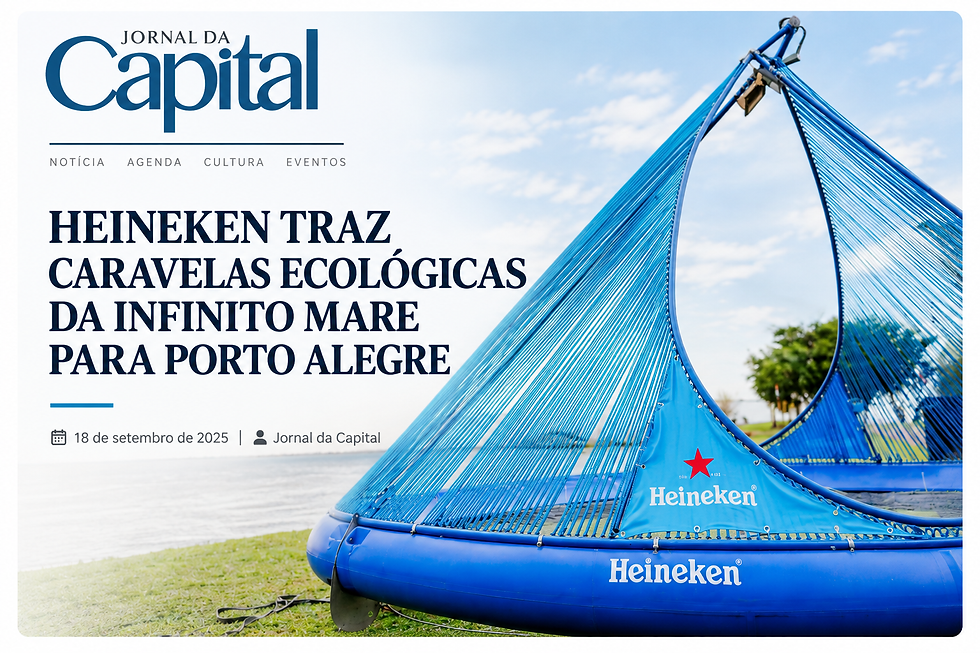

36 MEDIA FEATURES & STORIES across television and other media
15 POSTS
about the project

4.6 MILLION PEOPLE
reached
65,000 INTERACTIONS
across Infinito Mare’s social media channels

CONNECTED IMPACT
ONE TERRITORY.
MULTIPLE DIMENSIONS
OF IMPACT.
The Porto Alegre operation connected water, science, climate, circularity, innovation, and collaborative networks.
Together, these different dimensions aligned the project with multiple Sustainable Development Goals,
showing how a single operation can generate
impacts across different dimensions
of the 2030 Agenda.

TWO WATERS.
ONE CITY.
NO TWO ANSWERS THE SAME.
Porto Alegre showed us that
there is no single kind of urban water.
Operating simultaneously in the Guaíba
and Arroio Dilúvio, the Caravelas encountered very different dynamics, responses, and challenges.
The biomass was different.
The elements were different.
The pathways were different.
So were the learnings.
More than comparing two sites, the operation revealed how each aquatic system carries the traces of the territory it flows through.

THE FIRST CYCLE ENDED.
THE PRESENCE DID NOT.
The partnership with Marina Pontal made it possible for this story to continue.
Today, two Caravelas remain side by sidemat Parque Pontal, continuing the observation, research, and generation of data on the Guaíba.
THROUGH SEPTEMBER 2026 planned presence of the Caravelas at Pontal
And perhaps this is one of the most important lessons
Porto Alegre left us with:
TO CARE FOR WATER,
WE MUST FIRST
LEARN TO READ IT.
And remain present
to follow what it reveals.