
Completed
Belo Horizonte (MG), Brazil
LAGOA DA
PAMPULHA
Urban lake enviroment
April – July 2025
The Caravelas were installed at Lagoa da Pampulha, in Belo Horizonte, part of one of Brazil’s most iconic cultural landscapes and recognized as a UNESCO World Heritage Site.
More than a landmark, Pampulha is a territory where water, landscape, architecture, and memory come together.
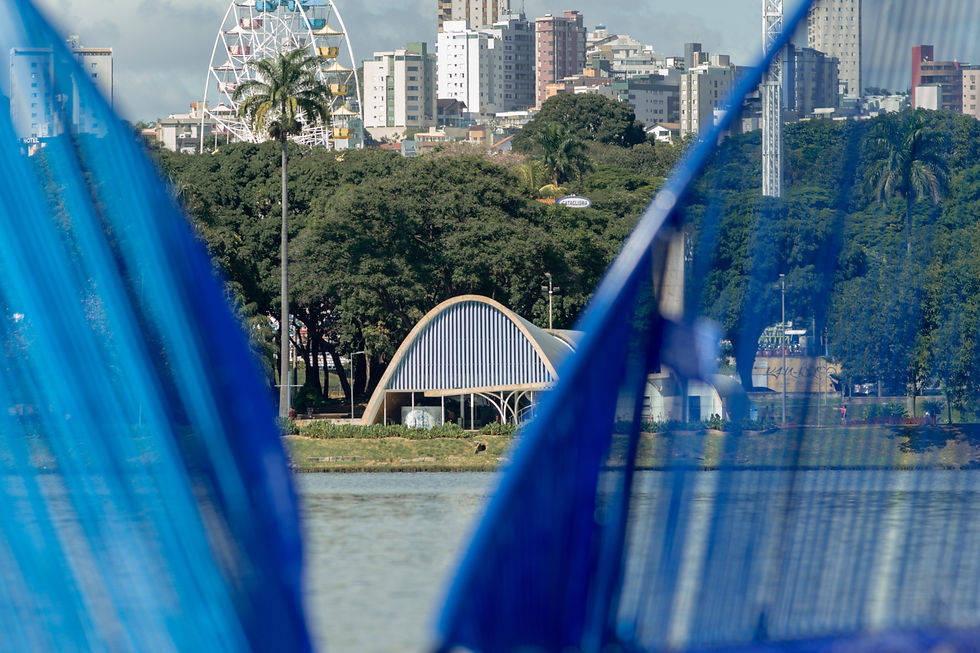
Throughout the operation, the fleet of Caravelas temporarily became part of the lake’s landscape, entering into dialogue with Oscar Niemeyer’s architecture and reinforcing the role of water as an essential part of this cultural and natural heritage.
WHY THIS TERRITORY MATTERS
Created in the 1940s as part of Pampulha’s urban development project, the lake plays a central role in Belo Horizonte’s identity.
Over the decades, the territory has faced persistent environmental challenges, particularly those related to excess nutrients, sedimentation, and water quality.
Working in Pampulha meant contributing to one of Brazil’s most widely recognized urban environmental challenges,
demonstrating how nature-based solutions can support the regeneration of complex aquatic environments.
More than caring for a lake, it was about caring for a living heritage.


Deployment of a fleet of four Caravelas
Continuous ecological monitoring
Circular use of biomass
Environmental data generation
Environmental education and citizen science
Nature-based ecological remediation
CARE, BUILT TOGETHER
The project was led by Infinito Mare in partnership with Zurich Insurance, which sponsored the operation.
The project was carried out with the required authorizations and oversight from the environmental and heritage authorities
responsible for the territory, including municipal, state, and federal institutions.
Research and analyses associated with the operation were conducted in collaboration with institutions including USP and UFF, with technical support from Visão Ambiental, a company specializing in environmental consulting and analysis.
The operation also brought together researchers, educators, and local organizations, strengthening the connection between science, heritage, and environmental regeneration.


WHAT THIS WATER REVEALED
Pampulha was the first territory to host a fleet of Caravelas operating simultaneously.
Throughout the project, biomass growth, monitoring campaigns,
and the continuous generation of environmental data
deepened our understanding of the lake’s ecological dynamics.
But the lessons extended beyond the water.
The presence of the Caravelas revealed the potential of nature-based solutions to create new forms of dialogue with the city.
Residents, visitors, students, and public officials were able to engage more closely with the ecological processes unfolding in the territory.
Pampulha also showed us that regenerating our waters can also be a way of caring for landscape, memory, and heritage.
A new presence in Pampulha


Science in the field

Life taking shape


Learning from the lake

Water, culture & heritage


WHAT THIS TERRITORY REPRESENTS
Lagoa da Pampulha marks a defining moment in Infinito Mare’s journey.
It was here that the technology began operating at scale, with a fleet of Caravelas deployed across different points of the lake.
It was also our first project within a UNESCO World Heritage Site, demonstrating that environmental regeneration and heritage preservation can move forward together.
The operation marked the beginning of the Caravela’s commercial deployment, turning years of research, development, and validation into a solution operating in a real-world environment.
More than a project, Pampulha represented a transition: from experimental technology
to real-world deployment at scale.
The project also generated new data on the lake’s ecological dynamics, expanding our understanding of one of Brazil’s most iconic urban aquatic systems.
During the operation, the Caravelas were the only technology authorized to operate directly on the waters of Lagoa da Pampulha, making processes of regeneration,
monitoring, and care visible within one of the country’s most significant heritage landscapes.
The experience showed us that caring for water also means caring for landscape,
culture, and collective memory.
The knowledge and insights gained in Pampulha continue to inform new approaches
to working in complex urban territories with strong cultural and symbolic significance.
Pampulha showed us that innovation, heritage, and regeneration can share the same landscape.